

About the object
Building type: monastery, defensive
Location: Ukraine, Khmelnytskyi region, Horodotskyi district, village of Satanіv.
Address: Slobidka of Sataniv
Start date of construction: unknown, already existed in 1600
Heritage Status: Architectural Landmark of National Importance
Status: open to the public
FUE status: fundraising stage
Correspondent: Larisa Nagliy
Historical excursion
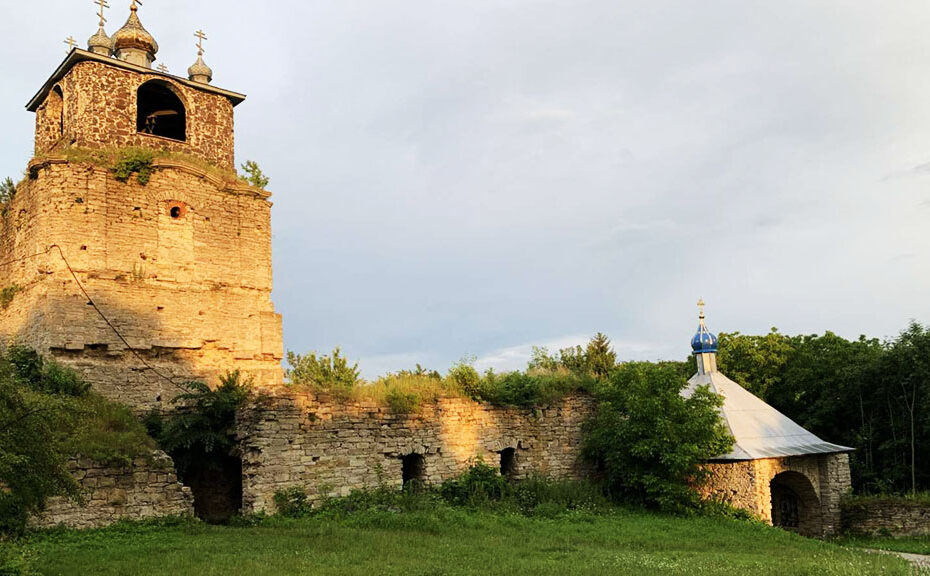
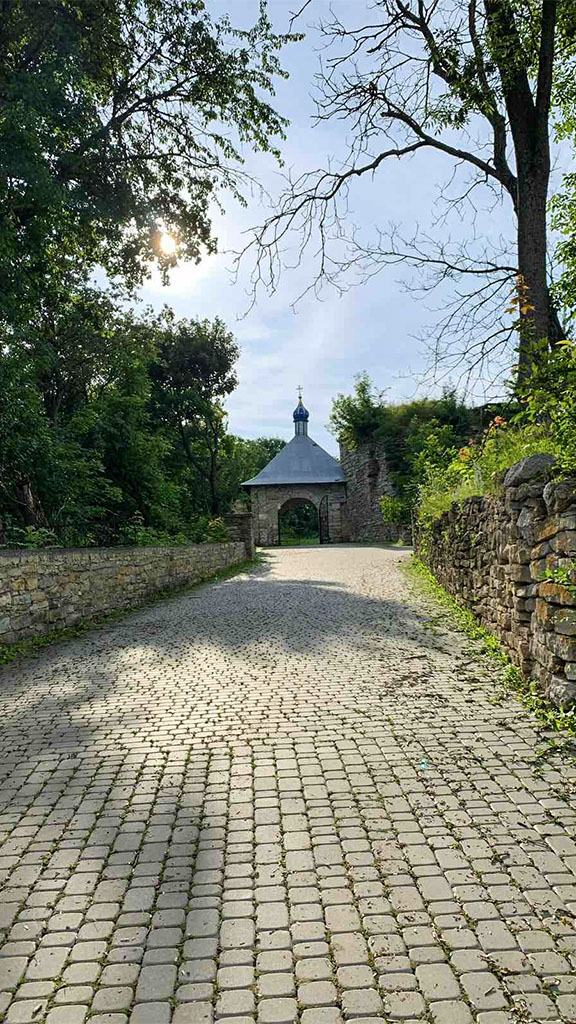
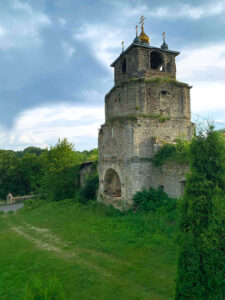
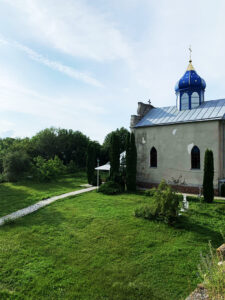
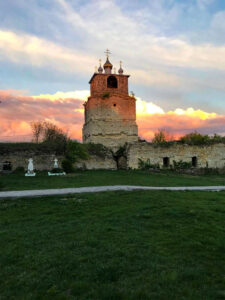
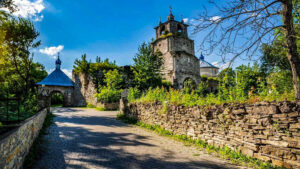
Holy Trinity Monastery of the 16th-18th centuries is an Orthodox convent and a valuable landmark of the defensive architecture of medieval Ukraine. There was a powerful Orthodox cell here in the past, which few people know about now.
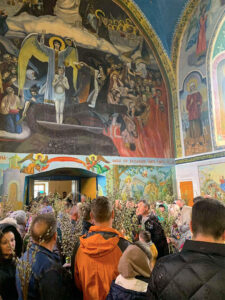
In 1709-1793 it was a Uniate male monastery of the Chin of St. Basil the Great, since 1793 – an Orthodox male, and since 1899 – a female monastery.
Sataniv has been documented since 1404. Since 1641 it had the status of a city. According to one version, the name Sataniv comes from the expression “sat aut non” (“it is enough to go further”) – this question was allegedly asked by the Roman soldiers to the commander Tonilius, having come to this place during the conquest of Dacia under Trajan. Being on the border of the Lithuanian-Polish state, Sataniv was burnt down more than once by the Krymchaks and Turks in the 15th-17th centuries, and stone fortifications were built here in the 18th century.
The founders of the monastery are considered to be Lavra monks who fled from Kyiv defiled by Batu. There is also a legend according to which the Sataniv Monastery is even more ancient. Like, some monk from Athos settled here half a century before the baptism by Volodymyr of Ukraine-Rus and lived here in the caves as a hermit.
According to legend, all the nuts are not only in the yard, but also in the immediate vicinity – the descendants of the seedlings brought by the monks from Athos are considered a local feature. They say that it is the monastery nuts that have healing power.
According to legend, in 981, during a campaign against the Poles, Prince Volodymyr the Great himself visited the caves. At first glance, the story is absolutely unfounded, because at that time the prince was still a pagan. But it shouldn’t be completely dismissed either. Firstly, the army of Prince Volodymyr really passed through this land. Secondly, a significant part of the princely squad were Christian Varangians. The latter, having met the only Christian church on the territory of hundreds of kilometers, of course, wanted to pray before the battle. It is likely that the prince could indeed be among his Christian soldiers. Moreover, his grandmother, Princess Olga, was a Christian.
In 1703, an anti-feudal uprising broke out in the Podilskyi region under the leadership of the Cossack colonel Fedir Shpak, which was suppressed. Violent repressions began. One of the detachments of punishers, despite the protests of the monks, set up camp within the walls of the monastery, the cellars of which became dungeons. Thousands of Cossacks were martyred here. But the most terrible punishment awaited several hundred active rebels – they were walled up alive. In 1987, historians accidentally found a terrible evidence of those horrific events – dozens of mutilated skeletons. A copper plate with an engraved list of “crimes” before the Polish crown was nailed to each skull of the tortured with a wrought iron nail. Apparently, nails were driven into the heads of still living people.
Of the famous guests of the monastery, it is worth mentioning the Moscow Tsar Peter I. Returning home after the disastrous Prussian campaign of 1711, he stopped in Satanovo. And there was a funny story. Hoping to drag the Tsar of the Muscovites into the union, the Basilians sent the best preacher of the order, Hieromonk Yosyp Chyzhevskyi to Sataniv. But the tsar did not give a damn about the question of faith – in a purely Moscow manner, he considered the Church exclusively as one of the instruments of his power. And no more. During Chyzhevskyi hot sermon, Peter was frankly bored. The royal jester, in order to entertain the patron, crept up to Chyzhevskyi and with one wave of sharp sheep scissors skillfully (he trained on the boyars) cut off his long beard. In order to hush up the scandal and somehow console the preacher, the king gave him a handful of gold.
It is worth noting that in the twentieth century the monastery was closed twice. For the first time – in the early thirties – the communists could not allow the nest of “religious depravity” to function on the border with bourgeois Poland. Then, during the German occupation, the monastery came to life again. They closed it already under Khrushchev.
To date, a significant part of the dungeons has not yet been explored, and no one knows what secrets are hidden there.
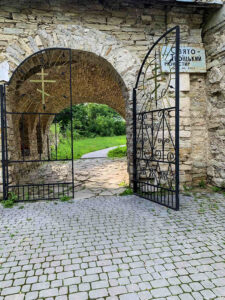
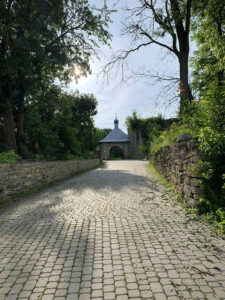
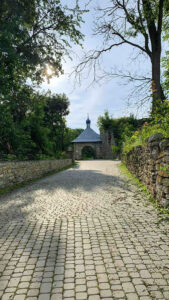
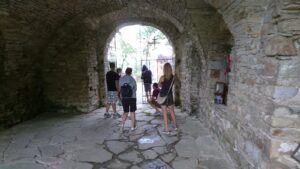
The inscription on the entrance gate: D. О. М. Adamus Nicolaus a Granow Sieniawski, Comes in Szklow et Mist, castelknus Cracoviensis, supreraus exercituum Rejrni dux, securitati publica propugnaculum hoc erexit anno Christi MDCCXXII. defensurus etiam muro pttnam quam toties pcctorc tutcbalur, provida scilicet mens fundatons, в Pertae Othom Micae via в Poloniam praecluderetur, portam hanc extrui curavit et в pan praesidio uleretur contra barbarorum incursions, fur clausa hostibus; sob tantum Dec, Regi та Patriae claus suas sit redditea Anno Domini 1724 року.
In translation, this inscription sounds like this: Adam Mykolai from Granov Seniavskyi, the owner of Shklov and Mykhailo, the kashtelian of Krakiv, the highest guide of the state army, for public safety restored this stronghold in the year of Christ in 1722, intending to defend the homeland with walls, which he defended so many times with his chest. So the supreme opinion of the founder took care to build in order to block the road to Poland for the Ottoman Porte, and in order to use equal force against the attacking barbarians, Sataniv opposed the fierce Tartar, against which even the gates of hell will not be overcome, more when (this stronghold) is closed to enemies; only God, the King and the Motherland will give his keys. – Year of God 1724.

News of the Fund's activity on the object
Posts not found
Рейтинг
Натисніть на зірку, щоб оцінити!
Середня оцінка 5 / 5. Кількість оцінок: 7
Оцінок наразі немає. Поставте оцінку першим.