


About the object
Building type: rotunda
Location: Ukraine, Transcarpathian region, Uzhhorod city
Address: Muzeinyi lane, 2
Construction period: XIII century
Founder: uncertain
Heritage Status: Architectural Landmark of National Importance
Condition: active church
FUE status: fundraising stage
Correspondent: Mykhailo Pryimych
Historical excursion
The modern Church of the Intercession of the Most Holy Theotokos, known as the Horianska rotunda, is referred to in other sources as the Church of St. Anna and the Church of St. Nicholas, although it looks like the oldest dedication of the temple was St. Ivan, which is mentioned in 1409.
The modern building consists of two parts different in time: the actual rotunda, which in the literature mainly dates from the 12th-13th centuries, and the completed elongated navy, dating back to the Gothic period – the 14th-15th centuries. The rotunda (modern sanctuary) is a circular structure, with six apses cut into the thickness of its walls (2–2.5 m), covered by a dome resting on a hexagonal drum. Outside, the drum is decorated with a brick ornament in the form of a curb. The indicated belt is a reconstruction by the architect Otto Steglo, which he probably carried out on the basis of the surviving fragments. Six windows have been preserved on the hexagonal drum, one of which opens onto the attic above the navoi. The thick wall of the structure is also cut through by two windows, of which only the eastern one is authentic, while the southern one is of a later origin. In 1921, on the south side of the rotunda near the immured portal, there was another window, the shape of which was lancet (due to restoration work, it was reopened). Given the current state of the building, it seems that the drum windows were the main source of light in the temple, which indicates other constructive solutions than we see in the rotundas of Kishzombor and Korça (Hungary). Therefore, despite the similarity of the plans of these buildings, it is not entirely correct to classify the buildings as one type.
Today, there are various versions regarding the construction time of the structure, in particular, there is an assumption that the building belongs to the X-XI centuries, however, the use of bricks measuring 30x30x4.5 indicates that it is thicker than plymph (27x31x3.5 cm, for example, in Sofiia Kyivska). For this reason, it is possible to date the structure to a later time, for example, the 13th century, although, according to Slovak researchers, the shape of the brick or the material is not always a reliable basis for dating the structure.
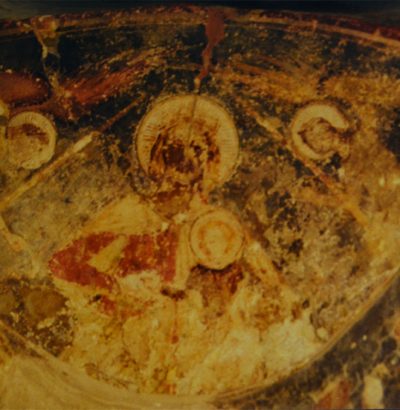
An interesting depiction of St. Yurii Zmiieborets in the northwestern conse of the rotunda, which, with its forms, rather corresponds to the style of Romanesque art. The Romanesque angularity of the horse and rider forms could point to the 12th century, when signs of this style still exist in Europe. And this would not contradict the historical background, because the Romanesque style in the Kingdom of Hungary remained relevant almost until the end of the 13th century. Therefore, based on the historical context and based on a comparative analysis, researchers today most often agree on dating this object of the 13th century. Certain reservations regarding the systematization and dating of the structure are put forward by researchers who, in addition to Western artistic influences, sought to consider eastern, Byzantine influences, relying, for example, on the structures of Armenia and Syria. In particular, the structure of the X-XI centuries is presented. from the city of Ani in Armenia, in terms of its structural and spatial features, it is close to the Horianska rotunda, but the material and size of the temple differ markedly.
Nava, built in the 15th century, although recent studies suggest the possibility of dating this part of the church to the 14th century. The nava is simple, covered with a plank ceiling, signs of the Gothic style appeared only in the main portal (lancet arch) and in the decoration of the portal architraves and three windows of the southern wall of the temple. Of particular interest is the northern Gothic portal, which is walled up today. In the 18th century a small baroque tower was placed on the western façade.
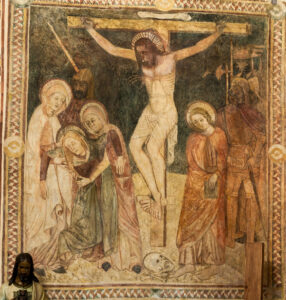
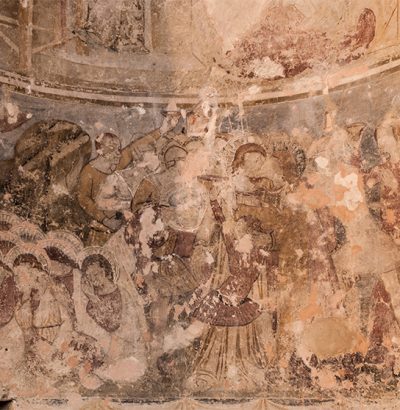
The first mention of the discovery of painting in the rotunda was published in 1879. The great attention to the temple of the National Committee of Architectural Monuments (Austria-Hungary) since 1894 led to a thorough study of the building, in particular, the first clearings and sketches were made by Otto Steglo. This allowed in 1911-1912. carry out the first work on the restoration of the church and frescoes. Then they strengthened the foundation of the rotunda, sewed up the cracks, cleaned the frescoes, built a new helmet-shaped roof. In 1926, excavations were carried out, which were led by M. Antal. At this time, the walls of the palace were studied. In 1932, another restoration of the frescoes was carried out; the last restoration of the painting in the rotunda took place in 1960-1962, when the walls were completely cleared. The last restoration work with significant tinting of the painting in the neva took place in 1992-1994. Today, there are ambiguous views on the various stages of the work of restorers, but thanks to the latter, there is a modern picture of the development of painting in the temple.
We have the first documentary evidence of the temple according to the charter of the magnate Amadeus Ili, who in the 1280s. from the lands that belonged to the Uzhhorod castle, he singled out the Nevytska estate, to which the Highlanders (Horiany) belonged. In 1334 and 1335 The highlanders are mentioned as a parish that paid 2 money of papal tithes. And this, in turn, gives reason to talk about the rotunda already in the XIV century. not only as a castle chapel. The events associated with the Protestant movements also had a bearing on the church, it is likely that at that time it was whitewashed. However, in 1644 the temple was mentioned as Catholic. The rotunda was an active church until 1959, after which it was closed. After clearing and restoration of frescoes in 1966, a branch of the Transcarpathian Museum of Local Lore was opened here. Since 1991, this is again the operating Greek Catholic Church of the Intercession of the Mother of God.
Horianska rotunda never ceases to arouse great interest not only in Ukraine, but also in many countries of Central Europe. In Ukraine, such a complex of painting of the XIV century simply not, but the historical vicissitudes in Hungary have led to the fact that artistic monuments closely related to the medieval history of Central Europe are often today outside the modern Hungarian state, which is of particular interest to both Hungarian tourists and scientists of this attraction.
Sources:
Sichynskyi V. Rotundas in Ukraine. K., 1929
Sights of architecture and urban planning of Ukraine. – M .: Technique, 2000
History of Ukrainian art. – K .: Scientific Thought, 1967
Sokach B. Horiany (Gerény, Greek Catholic Church) / Medieval Churches from Tisza to the Carpathians / under. ed. Tibor Kollar. – Niredgaz, 2013
Lohvyn G.N. Ukraine and Moldova. – M.: Art, 1982
History of Ukrainian art. – K .: Scientific Thought, 1967
Braided F. Cities and villages of Transcarpathia. Photographic materials from the private collection of Mykola Mushynka. – Uzhhorod – Prague, 2016
Horvath Z., Kovacs S. Karpatalja kincsei. – Budapest, 2002
Mogitich I. Preliminary remark to the “History of Ukrainian architecture” // Visnyk Ukrzakhidproektrestavratsiya. – Lviv, 2003. – No. 13
Mencl V. Stredoveká arhitektura on Slovensku. – Prague, 1937
Tajkov P. Sákralna architektura 11. – 13. st. on juhovychodnom Slovensku. – Košice : FU TU – 2012
Horvath Z., Kovacs S. Karpatalja kincsei. – Budapest, 2002
Logvin G.N. In Ukraine. – M.: Art, 1968
Moizhes V. V. Archaeological research of the Horianska rotunda // Scientific Bulletin of Uzhhorod University. Series: History, No. 2 (39) 2018
Melnik I. Restoration of the murals of the church of the church of St. Nicholas in Horiany.// Bulletin of the Institute Ukrzapadproektrestavratsiya. – Lviv, 1997. – No. 6
Zalozetskyi V. Horianska castle chapel // Scientific collection of the society “Prosvita”. – Uzhhorod, 1924
Exterior

Interior
News of the Fund's activity on the object
Posts not found
Рейтинг
Натисніть на зірку, щоб оцінити!
Середня оцінка 5 / 5. Кількість оцінок: 2
Оцінок наразі немає. Поставте оцінку першим.